
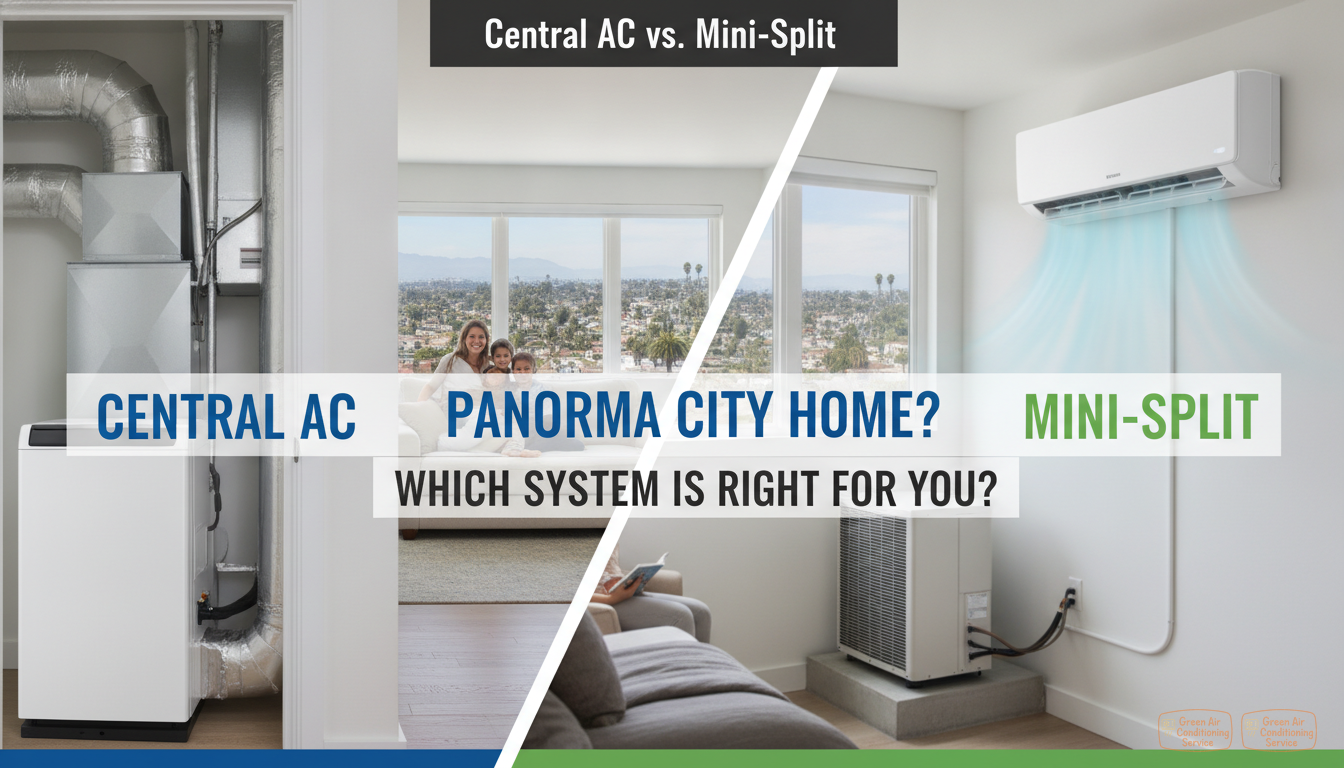
One of the most common questions we hear from Panorama City homeowners is: Should I go with central air conditioning or a ductless mini-split? Both systems will cool your home effectively, but they work very differently, cost different amounts upfront, and make more or less sense depending on your specific situation. This guide from Green Air Conditioning Service will walk you through the key differences so you can make a confident, informed decision.
How Each System Works
Central air conditioning uses a network of ducts to distribute cooled air from a single air handler (or furnace/air handler combination) throughout your entire home. The outdoor condenser unit and the indoor air handler work together as a system, and a single thermostat typically controls the temperature for all connected zones. If your home already has ductwork, adding or replacing central AC is usually straightforward.
Ductless mini-splits use the same refrigerant-cycle principle, but instead of routing air through ducts, each indoor unit (called a "head" or "air handler") mounts directly to a wall or ceiling in the room it serves. A small hole through the wall connects it to the outdoor unit via a refrigerant lineset and communication wiring. Multi-zone systems allow one outdoor unit to serve multiple indoor heads, each controlled independently.
Installation Requirements
If your home already has ductwork in good condition, a central AC installation typically costs less and takes one day to complete. We use Manual J load calculations to properly size the equipment so you avoid the performance problems that come with oversized or undersized systems — a detail many budget installers skip.
If your home has no ductwork, adding ducts can be expensive and invasive, especially in a single-story home with a slab foundation or a home with limited attic access. In those situations, a mini-split installation is often the more practical and less disruptive path. Mini-splits are also the go-to solution for room additions, converted garages, granny flats (ADUs), and finished bonus rooms that aren't connected to the main duct system.
Energy Efficiency
Modern central AC systems are available in high-efficiency configurations with SEER ratings in the mid-to-upper teens, which is a meaningful improvement over equipment from 10 or 15 years ago. However, duct systems inherently lose some efficiency — studies estimate that typical residential ductwork loses 20–30% of conditioned air through leaks and conduction before it reaches the living space.
Mini-splits eliminate duct losses entirely, and their inverter-driven compressors modulate output continuously rather than cycling on and off at full capacity. This makes them exceptionally efficient, particularly for individual rooms or smaller spaces. For a Panorama City home with aging, leaky ductwork, the efficiency difference can be substantial.
Regardless of which system you choose, pairing it with a regular AC tune-up each spring is the best way to maintain rated efficiency throughout the system's life.
Upfront Cost vs. Long-Term Value
Central AC systems generally have a lower installed cost per square foot of conditioned space when cooling a whole home, especially when ductwork is already in place. Mini-splits have a higher per-unit cost, and a whole-home multi-zone system can exceed the cost of central AC — though the efficiency gains and duct-loss elimination can offset that over time.
For cooling a single room, an addition, or a home without ducts, a single-zone mini-split is almost always the most cost-effective solution. For whole-home comfort in a house that already has good ductwork, central AC typically offers the better value proposition upfront.
Comfort and Zone Control
One of the most compelling advantages of mini-splits is the ability to set different temperatures in different rooms. If one family member runs warm and another runs cold, or if your home office needs to be cooler than the bedrooms during work hours, a multi-zone mini-split gives you that flexibility with independent thermostats for each head.
Central AC with a single thermostat treats the whole home as one zone. You can add smart zoning dampers and multiple thermostats to a central system, but that adds complexity and cost. For straightforward whole-home comfort, most homeowners find a single-thermostat central system perfectly adequate.
Maintenance Considerations
Both system types require annual maintenance to perform at their best. Central AC tune-ups include coil cleaning, electrical inspections, refrigerant pressure checks, and condensate drain clearing — all covered in our seasonal maintenance visit. If your home has ductwork, periodic air duct cleaning is also recommended, particularly in older San Fernando Valley homes where ducts may not have been serviced in many years.
Mini-splits require cleaning of the washable air filters in each indoor head every few weeks during heavy use, plus an annual professional service that covers coil cleaning, refrigerant checks, and outdoor unit inspection. Our team handles mini-split maintenance as part of our standard tune-up service.
Which One Is Right for You?
Here's a quick decision guide based on what we see most often serving Panorama City and nearby communities like Arleta and Van Nuys:
- Choose central AC if your home already has ductwork in reasonable condition, you want uniform whole-home cooling from a single thermostat, and upfront cost efficiency matters.
- Choose a mini-split if your home has no ducts, you're cooling a specific room or addition, you want zone-by-zone temperature control, or you're dealing with a space where running ductwork would be too invasive or expensive.
- Consider both if your home has central AC for the main living areas but an addition or garage conversion that isn't connected to the ducts — a single-zone mini-split for that space pairs perfectly with a central system for the rest of the home.
Not sure which direction makes the most sense for your specific home and budget? We offer free in-home estimates with no obligation. Our team will assess your existing setup, walk you through the options, and give you honest, straightforward guidance — not a sales pitch. Visit our Panorama City AC installation page or our
Call +18189365334 or fill out our online form for a free, no-obligation quote.Need Service?